

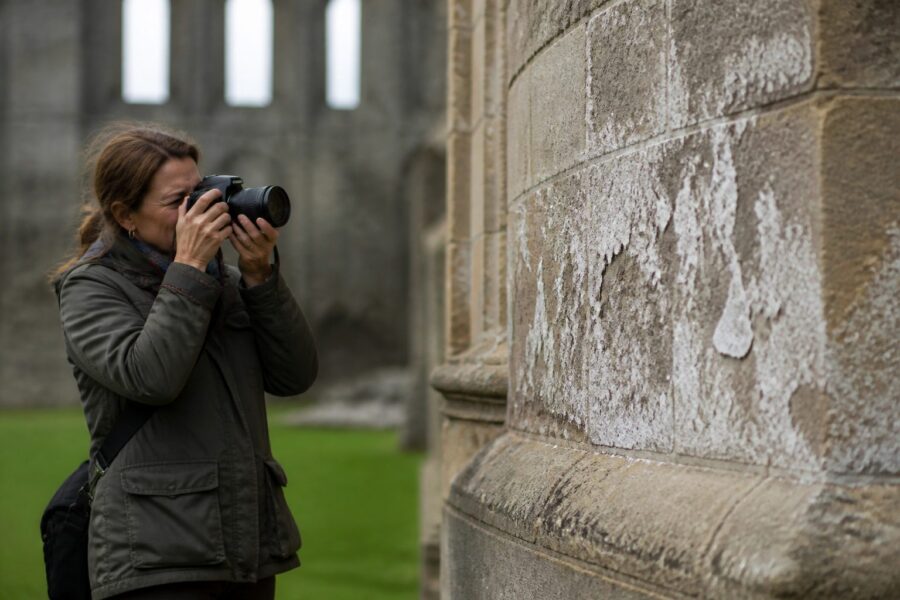
Salt weathering on historic stone can leave visible deposits, powdering, or loss of thin surface layers, but no single mark proves salts are the cause. Start by recording where the change occurs, how it looks, and whether it changes over time; use those observations to guide further assessment rather than choosing a treatment from appearance alone.
The term salt weathering describes stone deterioration associated with salts. In other words, weathering of rock caused by salt is called salt weathering; that name does not identify one single, fully settled mechanism. A review of theoretical research discusses several proposed mechanisms and notes the complexity of explaining how salt action produces damage.
Salts dissolved in moisture can move through porous masonry and remain at or below the surface as water evaporates. The National Park Service glossary describes visible efflorescence as a whitish salt haze and warns that it can accompany less visible salt accumulation beneath the surface.
Signs of salt weathering on historic stone
Efflorescence is a pale, powdery or crystalline-looking deposit on the face of masonry. It may be associated with salts moving through a wall, but the National Park Service notes that residues can also result from cleaning chemicals or inadequate rinsing, so a white deposit alone does not identify its source.
Subflorescence is a salt accumulation beneath or just below the surface, where it is harder to see directly. Surface deposits may point to this hidden condition, and pressure associated with salts and moisture can accompany flaking, delamination, or spalling; confirmation requires more than a visual glance, as the National Park Service glossary explains.
Look for small flakes lifting from the face, thin layers separating along a stone’s bedding, or irregular pieces breaking away. The National Park Service glossary describes these as distinct forms of deterioration and notes that moisture, salts, freeze-thaw action, stone layering, and other causes can overlap.
A granular or powdery surface, etched patches, or gradual loss of edges can also deserve documentation. The same glossary associates salt fretting with an erosion pattern in some settings, while its description of sugaring notes that gradual surface breakdown may have more than one cause.
There is no single stone type that can be called most affected by every form of chemical weathering. The National Park Service glossary, for example, notes that acid rain can damage acid-soluble carbonate stone; salt-related deterioration depends on the stone and the conditions that bring moisture and salts into contact with it.
Read the pattern, not just the deposit
Map the affected area against the wall’s features: ground level, joints, ledges, openings, roof lines, and any visible water paths. A pale band near the base, a patch below a ledge, or deterioration concentrated at a joint can help describe where moisture may be entering or moving, but location by itself does not establish the source.
Record whether the surface is dry or damp when observed, whether deposits are loose or firmly attached, and whether stone is lifting, powdering, or missing. Note nearby conditions such as staining, cracks, failed joints, or a visible leak without assuming that any one feature explains the others.
Repeat photographs from the same position and distance, with a scale or fixed architectural feature for reference, and date each record. The National Park Service’s stone-building guidance recommends cyclical documentation because comparing records over time can show whether a condition is changing.
A practical observation sequence
- Photograph the whole elevation, then the affected area and close details, without brushing or scraping the surface.
- Mark the deposit or deterioration on a simple elevation sketch and describe its color, texture, boundaries, and relation to joints or openings.
- Record visible moisture clues and recent changes you can verify, such as a newly noticed leak or a deposit returning after it was previously absent.
- Compare later observations with the dated record, noting whether the patch grew, shifted, disappeared, or was joined by flaking or material loss.
This record helps a preservation professional assess the condition and investigate possible moisture pathways. Salt mixtures and stone properties can complicate interpretation, so visual clues should not be treated as a laboratory identification or a complete diagnosis.
When the signs need closer assessment
Seek qualified conservation or building-preservation assessment when stone is actively detaching, deterioration is spreading, deposits recur, or the source of moisture is unclear. A National Park Service and University of Texas at San Antonio preservation manual advises focusing on underlying causes rather than the visible distress and cautions against trial-and-error interventions.
Avoid treating a salt mark as a cleaning problem by default. The National Park Service glossary explains that efflorescence can be associated with water entry and possible subsurface salts, and that some cleaning residues can also look similar; removing a deposit without understanding its origin may erase evidence while leaving the cause in place.
The useful next step is a dated, location-specific condition record and an investigation of moisture sources, not a conclusion based on color alone. Deposits, surface loss, and their change over time can help frame that investigation, while the limits of visual identification remain clear.
Sources
- A Glossary of Historic Masonry Deterioration Problems and Preservation Treatments — National Park Service (accessed 2026-11-09)
- Best Practices in Stone Building Preservation Management — National Park Service and University of Texas at San Antonio Center for Cultural Sustainability (accessed 2026-11-09)
- A review of theoretical salt weathering studies for stone heritage — Progress in Earth and Planetary Science (accessed 2026-11-09)