

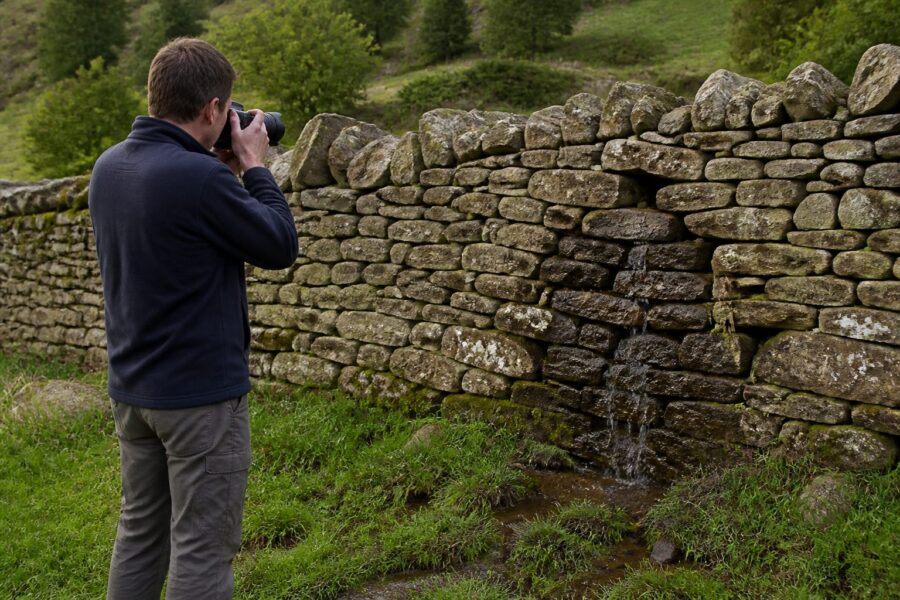
To inspect a dry-stone wall for repair needs, look for changes in its shape, displaced or missing stones, and signs that water or soil is moving through or behind it. Record what you can see from a safe distance; these observations can help identify when a closer assessment is warranted, but they do not diagnose the cause.
Dry-stone walls rely on stones fitted together without mortar, although a wall may have later repairs or a different concealed structure. The National Park Service describes visible displacement, bulging, water seepage, and deteriorated stone at a historic retaining wall, while noting that important conditions inside or behind a wall may not be visible from its face.
Inspect a dry-stone wall for repair needs safely
Choose a position where you do not need to stand on the wall, climb over it, or approach loose stones. If a section appears unstable or stones are falling, keep clear and arrange an assessment rather than touching or testing it.
Photograph the full length from the same viewpoints and include close views of areas that look different. Note the date, recent heavy rain or freeze-thaw conditions if known, and any nearby change in grading, drainage, or construction; the National Park Service’s wall case study shows why documenting water problems and stone movement together can matter.
Check the wall’s profile and alignment
From a few steps back, look along the face and top rather than judging one stone in isolation. A new lean, a bulge, a kink in the top line, or a section that seems to have shifted relative to adjacent sections is more useful to record than an impression that the wall simply looks old.
The condition-assessment guidance in STRUCTURE magazine describes outward lean, bulging, uneven top alignment, and ground changes as possible signs to evaluate together. It also cautions that a visual check may not reveal hidden construction or a developing problem, so a sound-looking face is not proof of the wall’s internal condition.
Look for displaced stones and loss of support
Record stones that have fallen, moved outward, or left a new opening, along with gaps that appear to be widening or a top course that has become uneven. Do not push stones to see whether they move: that can disturb an already unstable area, and a hand test cannot establish whether the wall is sound.
The Dry Stone Walling Association’s inspection leaflet discusses alignment, bulges, overhangs, and stone stability when inspecting walling work. Those workmanship checks can help describe visible features, but the leaflet concerns inspection of construction and should not be treated as a universal specification for every existing wall or regional style.
Watch for water and changes around the wall
Note water flowing through the wall, persistent wet patches, newly eroded soil, a depression behind the top, or water collecting where it did not before. Record where and when you see it, especially after rain, without assuming that one wet spot identifies the cause.
A dry-stone face can allow water to pass through, but drainage conditions and later alterations vary. In its Harpers Ferry project, the National Park Service linked water buildup behind a semi-dry-laid retaining wall with stone movement and a partial collapse; the agency also explains that visible inspection alone could not establish all of the wall’s hidden construction.
Decide what to do with the observations
Compare current photographs with earlier ones if available, and describe changes rather than assigning a diagnosis. A clearly changing lean or bulge, repeated displacement, falling stones, or new water and soil movement are reasons to seek a site-specific assessment, particularly where the wall retains soil or is beside a place people use.
If the wall looks unchanged and no immediate hazard is visible, keep the dated photographs and notes for comparison during future checks. Do not use this visual guide to set a repair method: determining stability may require information about the wall’s depth, backing, foundation, and ground that a surface inspection cannot provide.
Common questions
How much does it cost to repair a dry stone wall?
This inspection guide cannot produce a reliable repair price from visible signs alone. Record the affected location and ask for a site-specific assessment and estimate before comparing proposed work.
Will homeowners insurance cover a failing retaining wall?
A visual inspection cannot determine coverage. Check the terms of the specific policy and ask the insurer how it applies to the wall and the circumstances involved.
How do you repair a stone wall?
First document the visible condition and identify whether the wall is changing; the right repair depends on the wall’s construction and the cause of movement. This article does not prescribe dismantling or rebuilding, and the STRUCTURE assessment explains why some conditions need investigation beyond the face of the wall.
Sources
- Masonry Team: Harpers Ferry High Street Retaining Wall — National Park Service (accessed 2026-11-09)
- Condition Assessment of Old Stone Retaining Walls — STRUCTURE magazine (accessed 2026-11-09)
- A Brief Guide to the Inspection of Dry Stone Walling Work — Dry Stone Walling Association of Great Britain (accessed 2026-11-09)
