
Compatible mortar for historic stone repairs is selected by comparing the proposed material with the stone, the surviving historic mortar, and the wall’s exposure, not by choosing a mix from the building’s age alone. There is no single mortar recipe that suits every stone wall.
The National Park Service advises that replacement mortar should be softer and more vapor-permeable than the masonry units, and no harder or less permeable than the historic mortar. Those are screening principles, not a substitute for project-specific assessment.
Start with the repair task and the wall
First identify what the proposed mortar must do: re-bed a loose stone, fill a loss within a stone, or replace deteriorated joints. These are different repairs, and a material suitable for one is not automatically suitable for another.
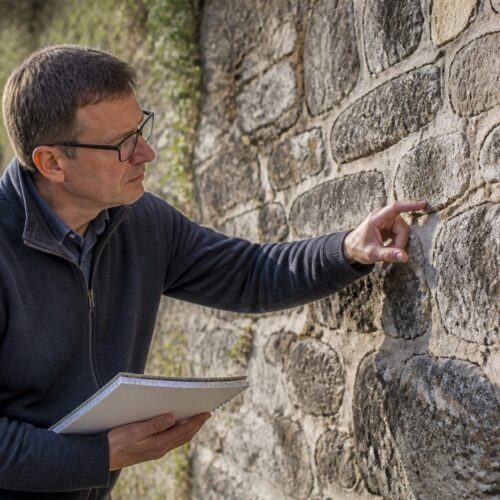
Record the stone type if known, the joint dimensions and profile, the wall’s condition, and signs such as open joints, cracking, dampness, powdering, or flaking stone. Photograph representative areas and note whether the problem is local or repeated across the wall.
Look for a cause before treating the mortar as the cause: a leaking gutter, roof defect, drainage issue, or movement can keep damaging replacement work. The National Park Service’s Preservation Brief 2 warns that repointing alone will not correct deterioration caused by underlying problems.
Compare the compatibility factors
Strength and movement
A mortar that is much harder than the surrounding stone can shift stress into the stone, where cracking or surface loss may be difficult to repair. Ask how the proposed mortar’s compressive strength compares with both the stone and any sound original mortar; a label such as Type N or Type S does not answer that question by itself.
The National Park Service explains that the right balance depends on the masonry and its use: a hard, dense stone may call for different properties than a softer, more porous stone. Do not infer the correct mortar from a generic type designation or a claim that stronger is safer.
Moisture movement
Water vapor needs a path out of many masonry walls. If the replacement mortar is less permeable than the stone, moisture and soluble salts may concentrate in the stone instead of passing through the joint, raising the risk of surface damage.
Ask for the basis of any permeability comparison and consider the actual exposure, including rain, ground moisture, shade, and freeze-thaw conditions where relevant. A mortar that performs acceptably on one wall may not behave the same way on a differently exposed wall.
Appearance and historic fabric
Color alone is not a compatibility test, but the sand’s color, grain size, and texture affect how a joint reads beside the stone. The National Park Service notes that examining historic mortar can inform a visual match, while a laboratory result should not be treated as a complete specification on its own.
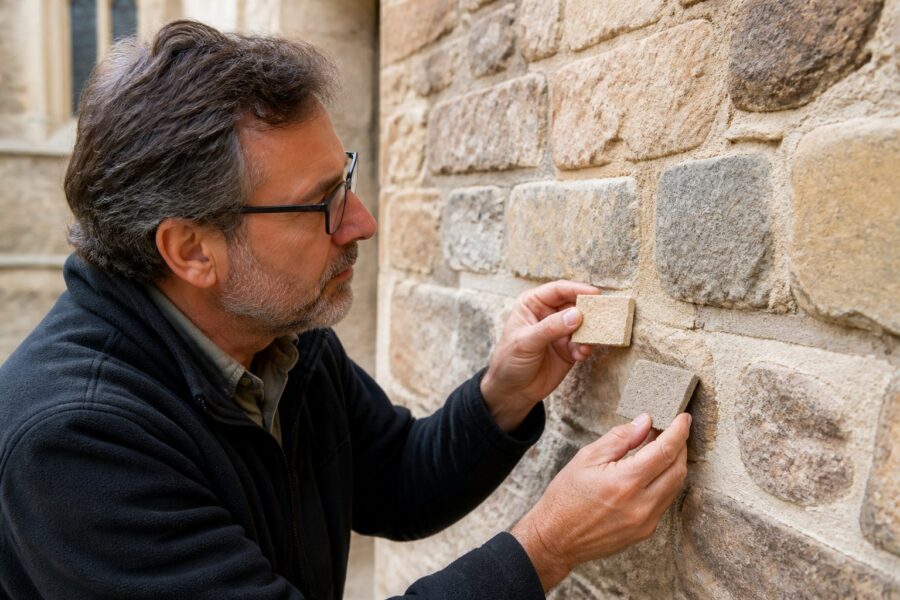
Compare the proposed joint’s texture, profile, and finish with surviving examples. Avoid judging a sample while wet, since its appearance can change as it dries.
Use evidence to narrow the options
For an old stone foundation, start by distinguishing sound original mortar from later repairs and mapping where each occurs. The National Park Service describes analyzing multiple samples when a building has distinct repair campaigns, since one sample may not represent the whole wall (Sharing the Mysteries of Mortar).
If the choice is uncertain or the building is significant, a qualified preservation professional can assess the wall and decide whether mortar analysis is warranted. The National Park Service notes that analysis can help identify ingredients, but factors such as original water content, curing, weather, and workmanship may not be recoverable from a sample.
Use findings to compare candidate mortars against the stone and surviving mortar, then request a small, inconspicuous test area or mockup before broader work. The General Services Administration’s procedure describes testing and approved mockups for its projects and cautions that its specifications need qualified, site-specific review.
- Ask what evidence supports the proposed strength and permeability for this particular stone and wall.
- Check whether the proposal addresses the repair function, joint dimensions, exposure, and surviving mortar.
- Review a dry mockup for color, grain, profile, and texture, as well as whether the work can be done without damaging adjacent stone.
- Resolve moisture or movement problems that could undermine the repair before approving the material.
Why a standard mix is not a reliable answer
Questions about the best mortar mix for stone work often assume that stone masonry has one standard answer. In practice, stone type, historic mortar, repair purpose, moisture behavior, exposure, and workmanship all affect the choice.
The practical decision is to select a mortar whose measured and observed properties suit the specific wall, then verify its appearance and application in a test area. If the evidence is incomplete, pause a broad repair specification and obtain a site-specific assessment rather than filling the gap with a universal recipe.
Sources
- Preservation Brief 2: Repointing Mortar Joints in Historic Masonry Buildings — National Park Service (accessed 2026-11-09)
- Repointing historic masonry — U.S. General Services Administration (accessed 2026-11-09)
- Sharing the Mysteries of Mortar — National Park Service (accessed 2026-11-09)