
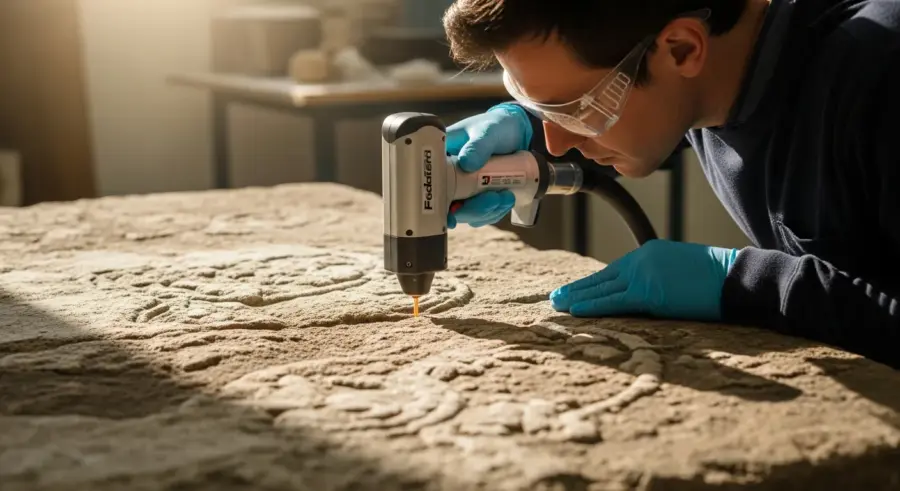
The world of lithic conservation is constantly evolving. New technologies emerge, offering innovative solutions for preserving our shared cultural heritage.
Among these advancements, laser cleaning stone has gained considerable attention as a precise and effective method. It’s transforming the way we approach the delicate task of stone surface cleaning and restoration.
This article will explore the science behind laser cleaning, its advantages over traditional techniques, and its practical applications in historic monument cleaning. We’ll also cover safety protocols to ensure responsible use of this powerful technology.
Understanding Laser Cleaning Technology for Stone
Laser cleaning stone is a non-abrasive cleaning method that uses focused beams of light to remove unwanted layers from a stone surface. The process relies on the principle of selective absorption.
Different materials absorb light at different wavelengths. By carefully selecting the laser’s wavelength, conservators can target specific contaminants without harming the underlying stone.
When the laser beam hits the surface, the targeted material rapidly heats up and either vaporizes or fragments into tiny particles. These particles are then easily removed, revealing the clean stone beneath.
This controlled ablation ensures that only the unwanted layers are removed, preserving the integrity of the original material. The precision offered by laser cleaning makes it ideal for delicate and intricate stone surfaces.
The science behind laser cleaning is rooted in photophysics and photochemistry. These principles govern how light interacts with matter at a molecular level.
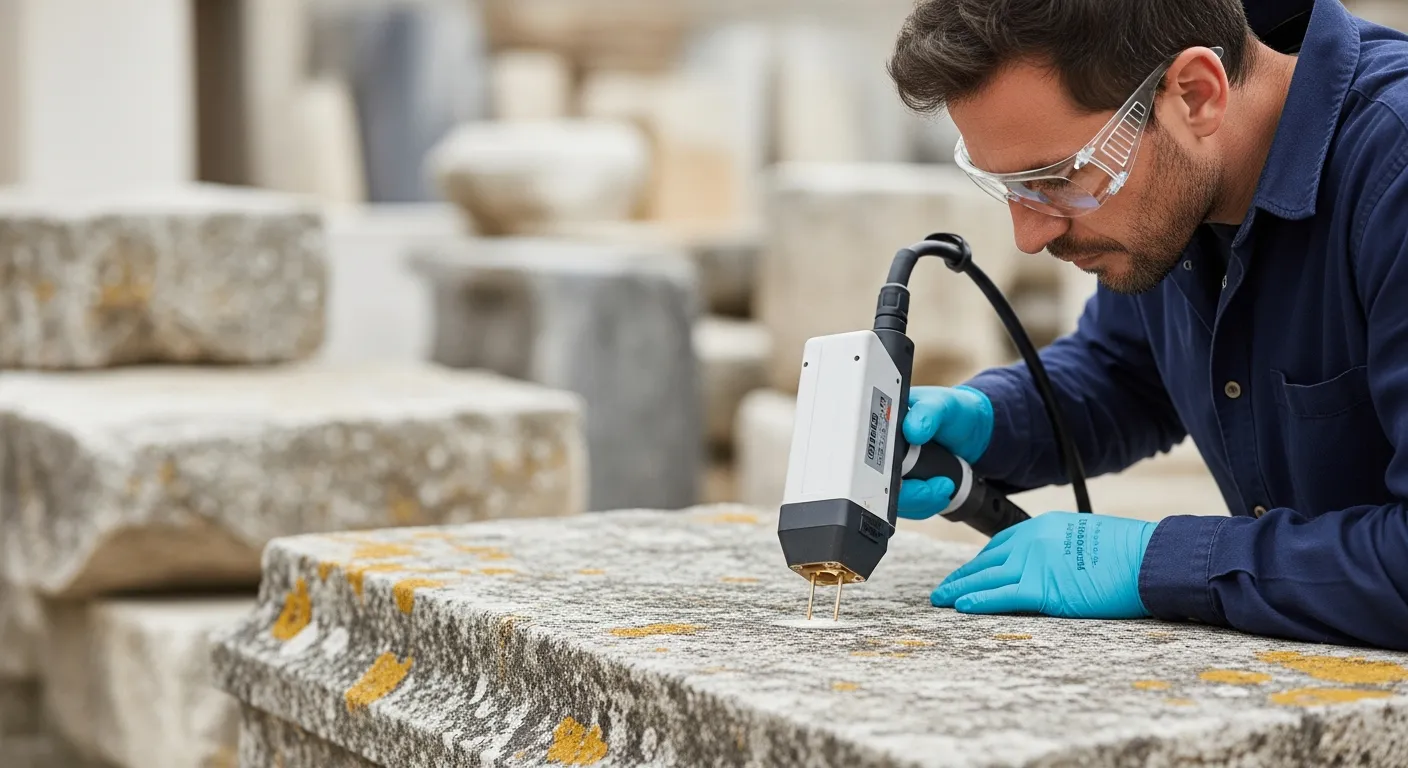
The laser emits a coherent beam of light, meaning the light waves are synchronized and travel in the same direction. This coherence allows the laser to focus the light into a very small spot, concentrating the energy.
When the focused laser beam interacts with a surface contaminant, the energy is absorbed. This absorption causes the contaminant to rapidly heat up, leading to its removal through various mechanisms.
The specific mechanism of removal depends on the laser parameters and the properties of the contaminant. Vaporization, ablation, and photochemical decomposition are all possible outcomes.
The key to successful laser cleaning lies in selecting the appropriate laser parameters for the specific application. This requires a thorough understanding of the stone and the contaminant being removed.
Factors such as the laser’s wavelength, pulse duration, and energy density must be carefully considered. These parameters determine the amount of energy delivered to the surface and the way in which it interacts with the material.
Different types of lasers are available for stone cleaning, each with its own unique characteristics. Nd:YAG lasers, excimer lasers, and fiber lasers are commonly used, each offering different advantages.
Nd:YAG lasers are versatile and can be used for a wide range of cleaning applications. Excimer lasers are particularly effective for removing delicate coatings and graffiti.
Fiber lasers offer high precision and control, making them suitable for intricate cleaning tasks. The choice of laser depends on the specific requirements of the project.
Benefits of Laser Cleaning Over Traditional Methods
Traditional stone cleaning methods, such as abrasive blasting or chemical treatments, can be harsh and damaging. These methods often remove not only the dirt and grime but also a layer of the original stone surface.
Laser cleaning stone, on the other hand, offers a gentler approach. Its non-abrasive nature minimizes the risk of damage to the substrate, making it a preferred choice for historic monument cleaning.
Another advantage of laser cleaning is its precision. It allows conservators to target specific areas, even those with intricate details, without affecting the surrounding material.
Furthermore, laser cleaning is environmentally friendly. It eliminates the need for harsh chemicals, reducing the risk of pollution and exposure to hazardous substances.
Traditional methods like abrasive blasting can leave a roughened surface, altering the original texture of the stone. This can be particularly detrimental to historic buildings where the surface finish is an important part of the aesthetic.
Chemical treatments, while sometimes effective, can pose risks to the environment and the health of workers. The chemicals can leach into the soil and water supply, causing pollution.
Laser cleaning, by contrast, produces minimal waste. The removed material is typically in the form of dust or vapor, which can be easily collected and disposed of safely.
The precision of laser cleaning also allows for selective removal of specific contaminants. This is particularly useful when dealing with complex soiling issues where different types of contaminants are present.
For example, laser cleaning can be used to remove graffiti without damaging the underlying stone. This is a significant advantage over traditional methods, which often struggle to remove graffiti without causing damage.
Another benefit of laser cleaning is its ability to clean in hard-to-reach areas. The laser beam can be directed into small crevices and intricate details, allowing for thorough cleaning of complex surfaces.
This is particularly important for historic monuments, where many decorative elements are often located in difficult-to-access areas. Laser cleaning provides a way to clean these areas without causing damage.
The non-contact nature of laser cleaning also reduces the risk of physical damage to the stone. Traditional methods often involve direct contact with the surface, which can lead to scratching or chipping.
Laser cleaning eliminates this risk, making it a safer option for delicate stone surfaces. This is especially important for historic monuments, where the preservation of the original material is paramount.
Types of Lasers Used in Stone Conservation
Several types of lasers are used in stone conservation, each with its own specific characteristics and applications. The choice of laser depends on the type of stone, the nature of the contaminant, and the desired outcome.
Some common types include Nd:YAG lasers, excimer lasers, and fiber lasers. Each type offers different wavelengths and pulse durations, affecting their suitability for various stone surface cleaning tasks.
| Laser Type | Wavelength (nm) | Pulse Duration | Applications |
|---|---|---|---|
| Nd:YAG | 1064, 532, 355, 266 | Nanoseconds | General cleaning, removal of black crust |
| Excimer | 193, 248, 308, 351 | Nanoseconds | Removal of delicate coatings, graffiti removal |
| Fiber | 1064 | Nanoseconds, Picoseconds, Femtoseconds | Precise cleaning, removal of paint and coatings |
| CO2 | 10600 | Microseconds, Continuous Wave | Surface preparation, removal of thick layers |
Nd:YAG lasers are widely used for general cleaning and removal of black crust. Excimer lasers are better suited for removing delicate coatings and graffiti.
The Nd:YAG laser is a solid-state laser that uses a neodymium-doped yttrium aluminum garnet crystal as its gain medium. It can emit light at several different wavelengths, including 1064 nm, 532 nm, 355 nm, and 266 nm.
The 1064 nm wavelength is in the infrared region and is commonly used for general cleaning and removal of black crust. The 532 nm wavelength is in the green region and is often used for removing organic contaminants.
The 355 nm and 266 nm wavelengths are in the ultraviolet region and are used for more delicate cleaning tasks. Excimer lasers use a mixture of noble gases and halogens as their gain medium.
They emit light in the ultraviolet region, typically at wavelengths of 193 nm, 248 nm, 308 nm, or 351 nm. Excimer lasers are particularly effective for removing delicate coatings and graffiti because the ultraviolet light is strongly absorbed by many organic materials.
Fiber lasers are a relatively new type of laser that is gaining popularity in stone conservation. They use optical fibers doped with rare earth elements as their gain medium.
Fiber lasers offer several advantages over traditional lasers, including higher efficiency, better beam quality, and greater stability. They can also be pulsed at very high frequencies, allowing for precise control of the cleaning process.
The choice of laser also depends on the pulse duration. Nanosecond lasers are commonly used for general cleaning, while picosecond and femtosecond lasers are used for more delicate cleaning tasks.
Shorter pulse durations allow for more precise removal of material with less heat transfer to the surrounding stone. This is particularly important for delicate stone surfaces that are sensitive to heat.
CO2 lasers are also used in stone conservation, primarily for surface preparation and removal of thick layers. These lasers emit infrared light at a wavelength of 10600 nm.
The longer wavelength is readily absorbed by many materials, making CO2 lasers effective for removing thick coatings and preparing surfaces for consolidation. However, they are not typically used for delicate cleaning tasks due to the higher heat input.
Factors Influencing Laser Cleaning Effectiveness
The effectiveness of laser cleaning stone depends on several factors. These include the laser’s parameters, the properties of the stone, and the nature of the soiling.
Laser parameters such as wavelength, pulse duration, and energy density play a crucial role. The stone’s composition, porosity, and surface roughness also influence the cleaning process.
The type and thickness of the soiling, as well as its adhesion to the stone, are important considerations. Understanding these factors is essential for optimizing the laser cleaning process and achieving the desired results.
Careful analysis of these variables allows conservators to tailor the laser cleaning approach. This ensures effective and safe removal of unwanted materials from the stone surface.
The laser’s wavelength determines which materials will absorb the laser energy most effectively. Different materials have different absorption spectra, meaning they absorb light at different wavelengths.
Selecting a wavelength that is strongly absorbed by the soiling but weakly absorbed by the stone is crucial for selective removal. Pulse duration affects the amount of heat transferred to the stone.
Shorter pulse durations, such as picoseconds or femtoseconds, minimize heat transfer and reduce the risk of thermal damage. Energy density, also known as fluence, is the amount of energy delivered per unit area.
Higher energy densities can remove soiling more quickly, but they also increase the risk of damage to the stone. The stone’s composition affects its absorption characteristics and its susceptibility to thermal damage.
Porous stones are more susceptible to damage because they can trap heat and moisture. Surface roughness can also affect the effectiveness of laser cleaning.
Rough surfaces can scatter the laser beam, reducing its energy density and making it more difficult to remove soiling. The type of soiling is another important factor.
Some types of soiling, such as black crust, are relatively easy to remove with laser cleaning. Others, such as deeply ingrained stains, can be more challenging.
The thickness of the soiling also affects the cleaning process. Thicker layers of soiling may require multiple passes with the laser to remove completely.
The adhesion of the soiling to the stone is another important consideration. Soiling that is strongly adhered to the stone may be more difficult to remove without damaging the underlying surface.
Preparing the Stone Surface for Laser Cleaning
Proper preparation of the stone surface is essential for successful laser cleaning. This often involves a preliminary assessment of the stone and the soiling.
The surface should be free of loose debris and surface coatings that could interfere with the laser’s effectiveness. In some cases, a gentle pre-cleaning may be necessary to remove thick layers of dirt or biological growth.
It’s also important to protect surrounding areas that are not to be cleaned. Masking or shielding can prevent accidental exposure to the laser beam.
A thorough understanding of the stone’s properties and the nature of the soiling is crucial. This will inform the selection of appropriate laser parameters and cleaning techniques.
The initial assessment should include a visual inspection of the stone surface. This helps to identify the type and extent of soiling, as well as any existing damage or deterioration.
Photographic documentation is also important to record the condition of the stone before cleaning. This provides a baseline for evaluating the effectiveness of the laser cleaning process.
Loose debris, such as dust, dirt, and biological growth, should be removed before laser cleaning. This can be done using a soft brush or a vacuum cleaner.
In some cases, a gentle pre-cleaning with water and a mild detergent may be necessary to remove thick layers of dirt or biological growth. However, it’s important to avoid using harsh chemicals or abrasive cleaning methods that could damage the stone.
Surface coatings, such as paint or varnish, can also interfere with the laser’s effectiveness. These coatings may need to be removed before laser cleaning.
The method used to remove surface coatings will depend on the type of coating and the type of stone. In some cases, a solvent or a chemical stripper may be used.
However, it’s important to test the solvent or stripper on a small, inconspicuous area of the stone before applying it to the entire surface. Masking or shielding should be used to protect surrounding areas that are not to be cleaned.
This can be done using tape, plastic sheeting, or other protective materials. The masking should be carefully applied to ensure that it is securely attached to the surface and that it completely covers the areas that are not to be cleaned.
A thorough understanding of the stone’s properties is essential for selecting the appropriate laser parameters. This includes the stone’s composition, porosity, and surface roughness.
The nature of the soiling is also important to consider. This includes the type of soiling, its thickness, and its adhesion to the stone.
The Laser Cleaning Process: A Step-by-Step Guide
The laser cleaning process typically involves several steps. These steps ensure a controlled and effective removal of unwanted materials from the stone surface.
First, the laser parameters are carefully selected based on the assessment of the stone and the soiling. Then, the laser beam is directed onto the surface, systematically scanning the area to be cleaned.
- Initial surface assessment and documentation
- Selection of appropriate laser type and parameters
- Protective masking of surrounding areas
- Systematic scanning of the stone surface
- Monitoring and adjustment of laser parameters
- Post-cleaning inspection and documentation
The cleaning process is closely monitored to ensure that the desired level of cleaning is achieved. Adjustments to the laser parameters may be necessary to optimize the results.
The initial surface assessment and documentation are crucial for establishing a baseline. This involves a detailed visual inspection of the stone surface to identify the type and extent of soiling, as well as any existing damage or deterioration.
Photographic documentation should be comprehensive, capturing the overall condition of the stone and any specific areas of concern. The selection of the appropriate laser type and parameters is based on the findings of the surface assessment.
Factors such as the type of stone, the nature of the soiling, and the desired level of cleaning will influence the choice of laser and its settings. Protective masking of surrounding areas is essential to prevent accidental exposure to the laser beam.
This involves carefully applying tape, plastic sheeting, or other protective materials to cover areas that are not to be cleaned. The masking should be securely attached to the surface to prevent it from being dislodged during the cleaning process.
Systematic scanning of the stone surface ensures that the entire area is evenly cleaned. The laser beam is typically moved in a raster pattern, with overlapping passes to ensure complete coverage.
The speed of the scanning and the overlap between passes will depend on the laser parameters and the nature of the soiling. Monitoring and adjustment of laser parameters are necessary to optimize the cleaning process.
The conservator should closely observe the cleaning process and make adjustments to the laser parameters as needed to achieve the desired results. This may involve changing the laser power, pulse duration, or scanning speed.
Post-cleaning inspection and documentation are essential to evaluate the effectiveness of the laser cleaning process. This involves a visual inspection of the cleaned surface to assess the level of cleaning and to identify any areas that may require further treatment.
Photographic documentation should be repeated to compare the condition of the stone before and after cleaning. This provides a record of the cleaning process and its results.
Applications of Laser Cleaning in Historic Monument Cleaning
Laser cleaning has found widespread application in the conservation of historic monuments. Its precision and non-abrasive nature make it ideal for delicate and valuable structures.
It’s used to remove black crust, graffiti, paint, and other unwanted coatings from stone surfaces. Laser cleaning stone can restore the original appearance of the monument without causing damage.
Many iconic landmarks have benefited from laser cleaning. The cleaning revealed intricate details and restored the beauty of the stone.
Laser cleaning is also used to prepare stone surfaces for consolidation or repair. This ensures proper adhesion of conservation materials and long-term preservation of the monument.
Black crust, a common form of soiling on historic monuments, is effectively removed by laser cleaning. This crust is formed by the deposition of pollutants from the atmosphere, such as sulfur dioxide and particulate matter.
Laser cleaning removes the black crust without damaging the underlying stone, revealing the original color and texture. Graffiti is another common problem for historic monuments.
Laser cleaning can be used to remove graffiti without damaging the stone, even on delicate surfaces. Paint removal is also a common application of laser cleaning in historic monument conservation.
Laser cleaning can remove paint layers without damaging the underlying stone, preserving the original surface. The preparation of stone surfaces for consolidation or repair is another important application of laser cleaning.
Laser cleaning can remove loose or deteriorated material, creating a clean and stable surface for the application of conservation materials. This ensures proper adhesion of the conservation materials and long-term preservation of the monument.
Laser cleaning has been used to clean numerous iconic landmarks around the world. These include cathedrals, museums, and other historic buildings.
The cleaning has revealed intricate details and restored the beauty of the stone, enhancing the aesthetic appeal of the monuments. Laser cleaning is also used to remove biological growth from stone surfaces.
Biological growth, such as algae and lichens, can damage stone surfaces and detract from their appearance. Laser cleaning removes the biological growth without damaging the stone, preserving the original surface.
The versatility of laser cleaning makes it a valuable tool for historic monument conservation. It can be used to address a wide range of cleaning challenges, from removing black crust to preparing surfaces for repair.
Safety Considerations for Laser Cleaning Operations
Laser cleaning operations require strict adherence to safety protocols. Lasers can pose potential hazards if not handled properly.
Eye protection is paramount. Operators and anyone in the vicinity must wear appropriate laser safety glasses to prevent eye damage from the laser beam.
Skin protection is also important. Protective clothing should be worn to prevent skin exposure to the laser beam.
Proper ventilation is necessary to remove any airborne particles generated during the cleaning process. Training and certification are essential for anyone operating laser cleaning equipment.
Laser safety glasses must be specifically designed for the wavelength of the laser being used. The glasses must provide adequate optical density to block the laser beam and prevent it from reaching the eyes.
Laser safety glasses should be inspected regularly for damage and replaced if necessary. Protective clothing should include long sleeves, long pants, and gloves to prevent skin exposure to the laser beam.
The clothing should be made of a material that is resistant to laser light, such as cotton or leather. Ventilation is important to remove any airborne particles generated during the cleaning process.
These particles can be harmful to the respiratory system if inhaled. The ventilation system should be designed to capture the particles at the source and exhaust them to the outside.
Training and certification are essential for anyone operating laser cleaning equipment. The training should cover the principles of laser safety, the operation of the laser equipment, and the proper use of safety equipment.
Certification demonstrates that the operator has the knowledge and skills necessary to operate the laser equipment safely. A designated laser safety officer should be responsible for overseeing laser safety in the workplace.
The laser safety officer should develop and implement a laser safety program, conduct regular safety audits, and investigate any accidents or incidents involving lasers. Warning signs should be posted in areas where laser cleaning is being performed.
The signs should indicate the type of laser being used, the potential hazards, and the required safety precautions. The laser equipment should be properly maintained and inspected regularly.
This includes checking the laser power, the beam alignment, and the cooling system. The laser equipment should be stored in a secure location when not in use.
Case Studies: Successful Laser Cleaning Projects
Examining successful laser cleaning projects provides valuable insights into the technology’s capabilities. These case studies demonstrate the practical application of laser cleaning in diverse conservation settings.
One notable example is the cleaning of the Cologne Cathedral in Germany. Laser cleaning was used to remove black crust and pollution from the cathedral’s facade, revealing the original light-colored stone beneath.
Another case study involves the restoration of the Lincoln Memorial in Washington, D.C. Laser cleaning was employed to remove biological growth and staining from the marble surfaces, restoring the monument’s pristine appearance.
These projects highlight the effectiveness of laser cleaning in addressing various conservation challenges. They showcase the technology’s ability to preserve and enhance our cultural heritage.
The Cologne Cathedral, a UNESCO World Heritage Site, had suffered significant damage from air pollution over the centuries. The black crust that had formed on the facade obscured the intricate details of the stonework.
Laser cleaning was chosen as the preferred method for removing the black crust because of its precision and non-abrasive nature. The project involved carefully scanning the cathedral’s facade with a laser beam, removing the black crust layer by layer.
The Lincoln Memorial, another iconic landmark, had accumulated biological growth and staining on its marble surfaces. This had discolored the marble and obscured the monument’s inscriptions.
Laser cleaning was used to remove the biological growth and staining without damaging the marble. The project involved carefully adjusting the laser parameters to ensure that the marble was not harmed.
Another successful laser cleaning project involved the restoration of the Florence Baptistery in Italy. The Baptistery, known for its stunning bronze doors, had accumulated dirt and grime over the centuries.
Laser cleaning was used to remove the dirt and grime without damaging the delicate bronze surfaces. The project involved carefully controlling the laser power and scanning speed to prevent any damage to the bronze.
These case studies demonstrate the versatility of laser cleaning in addressing various conservation challenges. Laser cleaning can be used to clean a wide range of materials, including stone, marble, and bronze.
The success of these projects highlights the importance of careful planning and execution. The laser parameters must be carefully selected and controlled to ensure that the cleaning process is effective and safe.
The Future of Laser Cleaning in Stone Conservation
Laser cleaning technology continues to evolve, promising even more advanced solutions for stone conservation. Ongoing research and development are focused on improving laser systems and techniques.
One area of development is the use of advanced sensors and imaging systems. These systems allow for real-time monitoring and control of the laser cleaning process, enhancing precision and efficiency.
Another trend is the development of more portable and versatile laser systems. This will enable conservators to perform laser cleaning in a wider range of locations, including remote and difficult-to-access sites.
As laser cleaning technology advances, it will play an increasingly important role in preserving our cultural heritage. It will help to ensure that future generations can appreciate the beauty and history of our stone monuments and structures.
Advanced sensors and imaging systems can provide real-time feedback on the cleaning process. This allows conservators to adjust the laser parameters as needed to optimize the results and minimize the risk of damage.
These systems can also be used to create detailed 3D models of the stone surface. These models can be used to track the progress of the cleaning process and to identify any areas that may require further treatment.
The development of more portable and versatile laser systems is making laser cleaning more accessible. Smaller and lighter laser systems can be easily transported to remote and difficult-to-access sites.
This allows conservators to clean monuments and structures that would otherwise be impossible to reach. Another area of development is the use of artificial intelligence (AI) in laser cleaning.
AI algorithms can be used to analyze the stone surface and to automatically adjust the laser parameters to optimize the cleaning process. This can improve the efficiency and precision of laser cleaning and reduce the need for manual intervention.
The development of new laser wavelengths and pulse durations is also expanding the range of applications for laser cleaning. New lasers are being developed that can remove a wider range of contaminants without damaging the stone.
Shorter pulse durations are also being used to minimize heat transfer and reduce the risk of thermal damage. The integration of laser cleaning with other conservation techniques is another trend in the field.
Laser cleaning can be used in combination with other techniques, such as consolidation and grouting, to provide a comprehensive approach to stone conservation. This can improve the long-term durability of the treated stone and ensure its preservation for future generations.
Conclusion
Laser cleaning stone represents a significant advancement in lithic conservation. Its non-abrasive nature, precision, and environmental friendliness make it a valuable tool for preserving our cultural heritage.
As the technology continues to evolve, we can expect even more innovative applications in historic monument cleaning and stone surface cleaning. Laser cleaning stone is a powerful method for preserving the past for the future.
The ability to selectively remove unwanted materials without damaging the underlying stone is a game-changer. It allows conservators to address a wide range of cleaning challenges with greater confidence and control.
The environmental benefits of laser cleaning are also significant. By eliminating the need for harsh chemicals, laser cleaning reduces the risk of pollution and protects the health of workers and the environment.